
Beaufort County Court Records After Arrest
After a Beaufort County jail arrest, the jail record and court record split into two related but different tracks. The jail record shows local custody, booking status, inmate account needs, and sometimes release information. The court record shows the criminal case: charges pursued, hearings, court dates, dispositions, payments, probation, and judgments. A person can be booked into the Beaufort County Detention Center before every formal charge is fully reflected in the court case record.
The court system source is the North Carolina Judicial Branch. Its Beaufort County page identifies Superior Court District 2, District Court District 2, and Prosecutorial District 2. The same page links to court calendars and the NC eCourts Portal. For custody or booking status, use Beaufort County jail inmate records. For booking-photo questions, use Beaufort County jail mugshots. For the court records after arrest, follow the case and charge path.
The NC Judicial Branch Beaufort County page captured from the official court location source shows the county court portal links, courthouse access, court districts, criminal calendars, and online services used after a jail arrest.
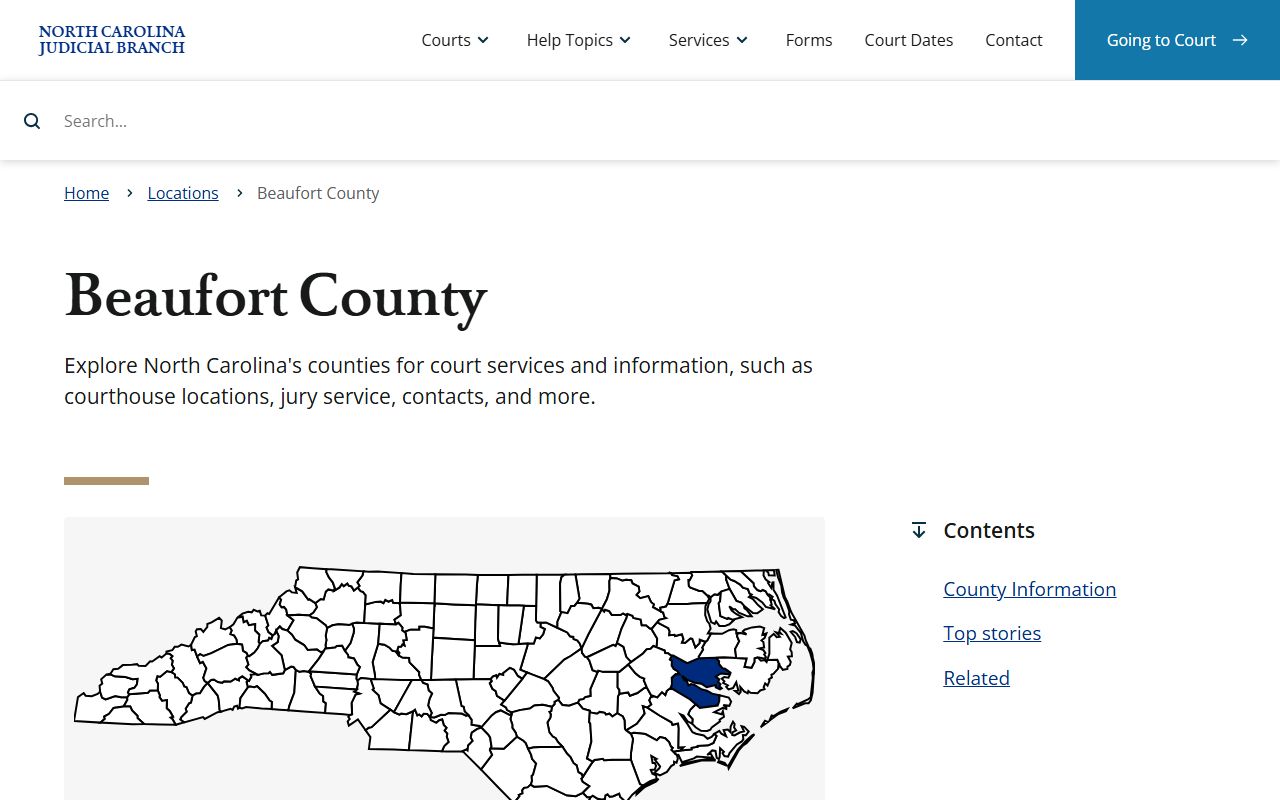
That page is the local court hub, while the statewide portal provides the searchable case tools.
Search Beaufort County Court Records
The main online case channel is the North Carolina eCourts Portal. The portal landing page lists Smart Search for court records and case information, Search Hearings for court dates and hearings by name, county, date range, and more, Make Payments for probation, parole, and some criminal or infraction cases, and NC Judgment Search. It also states that JavaScript and cookies must be enabled and that CAPTCHA appears every ten minutes for anonymous, registered, and elevated-access users.
- Start with custody status only if needed. The sheriff app or jail phone line answers whether the person is in the Beaufort County Detention Center.
- Open NC eCourts Portal and use Smart Search by name or case number when known.
- Use Search Hearings for court dates by name, Beaufort County, and date range.
- Open the case record and read each listed charge, status, hearing, disposition, and payment entry.
- Confirm the county is Beaufort County, North Carolina, not Beaufort County, South Carolina.
- For sealed, restricted, older, or unclear records, contact the Clerk of Superior Court through the courthouse main number.
| Portal Field or Tool | Type | Required | Notes |
|---|---|---|---|
| Smart Search | Portal tool | No | Searches court records and case information. |
| Search Hearings | Portal tool | No | Searches court dates and hearings by name, county, date range, and more. |
| Make Payments | Portal tool | No | Covers probation, parole, and some criminal or infraction cases. |
| Name | Text | Varies | The county page says court dates can be searched by name. |
| Citation number | Text | Varies | The county page says portal searches can use citation number. |
| County | Dropdown | Varies | Select Beaufort County for local cases. |
| Date range | Date fields | Varies | Used for hearing search. |
| CAPTCHA | Challenge | Yes periodically | Portal states CAPTCHA recurs every ten minutes. |
Beaufort County Courthouse Contacts
The courthouse is the fallback when NC eCourts does not resolve the court record after a jail arrest. The Beaufort County Courthouse page lists 112 W Second St, Washington, NC 27889, main number (252) 940-4000, and hours Monday through Friday, 8:00 a.m. to 5:00 p.m. The court contact directory also lists the District Attorney at (252) 940-4010 and Magistrates at (252) 940-4019.
Beaufort County Courthouse
112 W Second St
Washington, NC 27889
(252) 940-4000
Monday-Friday, 8:00 a.m.-5:00 p.m.
Prosecutorial District 2
District Attorney: Thomas Anglim
Beaufort, Hyde, Martin, Tyrrell, and Washington counties
(252) 940-4010
Thomas Anglim was appointed District Attorney for Prosecutorial District 2 on January 3, 2025, according to the NC Judicial Branch announcement. The DA decides how state criminal charges are prosecuted, whether counts are amended or dismissed, and whether felony matters move toward indictment. Jail staff do not make those charging decisions.
For a reader comparing sources, the clerk and DA roles should not be blended. The clerk's office maintains court files, calendars, and public access to case records. The prosecutor decides how to proceed on state charges. Magistrates often handle initial criminal process and release conditions. Each office can answer a different part of the arrest-to-court path.
Charging Records After Arrest
Court records after a Beaufort County arrest can begin from more than one charging path. A law-enforcement officer may arrest on a warrant, a magistrate may process initial criminal charges, or the prosecutor may later pursue a different formal charge. Felony cases may require a grand-jury indictment unless waived or handled through another lawful route. The first booking charge should be treated as an accusation, not as the final case result.
| Document | Common Source | Role in the Case |
|---|---|---|
| Complaint or magistrate process | Officer, magistrate, or prosecutor | Starts or supports the initial criminal charge after arrest. |
| Information | Prosecutor | Formal charging document used when permitted by law. |
| Indictment | Grand jury | Felony charging document returned as a true bill for prosecution. |
Beaufort Court Charge Status
A charge status is a snapshot of the court case, not proof of guilt. Charges may be added, amended, reduced, dismissed, indicted, disposed, or resolved by plea or trial. A jail roster entry may lag behind a court update, and the court file may use more precise statutory language than the booking screen. When the charge wording matters, verify the current court record.
| Status | What It Means |
|---|---|
| Pending | The charge or case is still open. |
| Amended or reduced | The prosecutor or court changed the charged offense or level. |
| Indicted | A grand jury returned a true bill for felony prosecution. |
| Dismissed | The charge ended without a conviction on that count. |
| Disposed | The charge has a final court outcome. |
| Conviction | Guilt was adjudicated by plea, verdict, or judgment. |
| Deferred or prayer for judgment | North Carolina outcome that may need court or lawyer interpretation. |
Warrants Before Court Records
No official Beaufort County active-warrant web search was located. The practical channels are the sheriff's office, magistrate, clerk, NC eCourts, and public-records request path. Returned arrest warrants and returned search warrants are generally court records unless sealed under North Carolina law. An unserved active warrant is a different concern because appearing in person may result in arrest.
Warrant terms should be read with care. An arrest warrant authorizes arrest based on a criminal charge or probable cause. An order for arrest often follows failure to appear, probation violation, or other court noncompliance. A bench warrant comes from a judge. A search warrant authorizes a search, while a fugitive hold involves another jurisdiction. Once a person is arrested, magistrate review, bond conditions, and jail booking may follow before the court case is fully visible online.
First Appearance and Bond
Bond and release information sits between jail records and court records after arrest. Beaufort County's jail services page says bail bonding is app-only and allows users to search inmates and initiate the bail process. The public page does not publish a bond payment method list, bail-agent list, or full local fee table. Conditions of release can include written promise, unsecured bond, secured bond, cash bond, surety bond, no-bond order, or another hold.
Another hold can change the result even when a bond amount appears. A person may have a probation matter, another county warrant, federal detainer, ICE interest, hospital transport, identity issue, or no-bond judicial order. Confirm the release path before relying on a single app or portal entry.
| Bond Type | How It Works | Why It Matters |
|---|---|---|
| Written promise | Release based on promise to appear. | No upfront money, but court attendance is required. |
| Unsecured bond | No upfront payment, but money may be owed after failure to appear. | Still a formal court condition. |
| Secured bond | Requires cash, property, or surety backing before release. | Often involves a bail agent or court-approved payment. |
| No-bond or hold | Ordinary payment will not cause release. | May involve domestic violence, probation, another county, federal, or ICE custody. |
Charges Versus Convictions
A Beaufort County arrest does not equal a conviction. A charge is an accusation that the state must prove or resolve through a lawful disposition. A conviction is a final finding of guilt by plea, verdict, or judgment. That distinction matters when reading court records, jail records, warrants, and background information.
| Point | Charge | Conviction |
|---|---|---|
| Stage | Accusation after arrest or filing | Final guilt result by plea, verdict, or judgment |
| Proof level | Probable cause or formal allegation | Beyond a reasonable doubt or accepted plea |
| Can change | May be amended, reduced, or dismissed | Can be appealed, corrected, or expunged only through legal process |
| Record source | Court portal, charging papers, calendars | Judgment, disposition, sentencing, probation records |
Sealed and Expunged Records
North Carolina public records law supports access to many public records, but not all criminal justice information is open. Law-enforcement investigative records are treated differently from basic arrest information under G.S. 132-1 and G.S. 132-1.4. Returned warrants and court records are generally public unless sealed. Expunction is a court process under Chapter 15A that may remove eligible arrest or case records from public systems depending on the disposition, offense, prior record, and waiting period.
| Point | Sealed | Expunged |
|---|---|---|
| Public view | Hidden or restricted by court order or statute. | Removed from public access when the court grants relief. |
| Record still exists? | Often retained with limited access. | Treated under the expunction order and related statutes. |
| How to confirm | Ask the clerk or review the court order. | Use the court process and confirm with the clerk. |
| Effect on private copies | May not remove copies already made elsewhere. | May not erase all third-party republication without separate action. |
Important: Court records after an arrest can be incomplete online. Verify sealed, expunged, and disposition-sensitive records with the clerk.